Group 4: Can violence be a means of defending Human Rights?
In recent years we’ve seen several examples of leaders trying to excuse the use of violence by saying it’s necessary to defend human rights. That was the case with the NATO interventions in Kosovo, the US attack on Iraq and the Egyptian emergency laws. But is violence, which in essense is opposed to human rights, a legitimate means to protect the very same rights?
It has always been debatable whether the use of violence is appropriate in the fight for human rights; some people say that if you run out of peaceful approaches, force is the shortest way of achieving enforcement of human rights. Yet the contradictory nature of this argument makes it less convincing. It is against the human nature to be forced to think in a certain way. Furthermore, violence brings violence. An eye for an eye and soon the whole world will be blind. This illustrates the unfruitful reality of using violence as a means for securing human rights. But how then, can human rights be spread and enforced?
Essentially, the question needs to be divided between how to spread human rights and how to make sure these are enforced. The former should be through convincing arguments and good examples. We need to explain why human rights benefit us all. The latter must happen through cultural and political pressure. In the case of Mohandas Gandhi we’ve experienced an example of how it’s possible through non-violent resistance to be successful in securing the enforcement of human rights.
This illustrates the need of a division between violence and power. While violence, due to its contradictory nature and the consequences thereof, is an undesired means of securing human rights, power can be used to achieve this goal. Power can be understood both in terms of knowledge and intellectual capabilities as well as political power. These instruments can and should be used to secure human rights as they both lie within the human rights themselves. Human rights is a universal package. Just choosing to enforce the rights that suit you is not a viable option. Other people will most likely have other priorities and in the end this approach means that none of the rights will be enforced.
So to answer the original question, whether violence is a legitimate means to protect human rights, the answer is: Probably not. Using power, both knowledge-based and political, is much more fruitful if your objective is to secure a continued enforcement of human rights.
Sunday, 14 March 2010

Monday, 1 March 2010
Group Three 1st Post : “ Are there limits to freedom of expression? “

This article has as a starting point several discussions about freedom of expression. In article 19 in the UN Universal declaration of human rights which state that “Everyone has the right to freedom of opinion and expression; this right includes freedom to hold opinions without interference and to seek, receive and impart information and ideas through any media and regardless of frontiers.”
It is great to create a platform for dialogue trying to bridge cultural gabs and to have one overall strategy for making the whole process work out by not only concentrating on the specific issues that people usually fights about but rather to cultivate our shared points of views from a wider perspective. We have had a lot of interesting discussions about the topic, and it is clear to us that we simply look at freedom of expression from different perspectives but debate is part of the dialogue and we don’t have always to agree to get along.
We will try the difficult, but interesting task, of presenting each other’s viewpoints. The Egyptian side will make the arguments of the Danes clear while the Danish side will present the viewpoints of the Egyptians. By this we hope to demonstrate that by understanding each other’s viewpoints we have come a long way. We do not have to change opinions, but by knowing how each other think and accepting the differences we have already gained a lot.
In our group we all agreed that freedom of expression is very important. But at the same time we realized that we have different opinions of and if there are limits of freedom of expression.
Most Egyptians believe that there are some limits to freedom of expression. These are very considered to be very important. You have the right to criticize political system or figures, society – even your family. But you cannot criticize without being backed by good arguments nor only for the sake of criticizing. Also, it is not okay to insult no matter what. You should not be allowed to say whatever you want when it hurts others feelings. The Egyptian side differs between well-argued criticism and insult. The first is considered okay whereas the second is not.
Whereas the Egyptian side would like some formalized limitations to freedom of expression so that it is not acceptable to hurt others feelings the Danish viewpoint differs a bit. In Denmark most people believe in the infinite freedom of speech/expression without any limitation. Anyone can say whatever s/he wants to say whenever s/he wants. The freedom of expression only has a limit if one urge to harm others physically. Most Danes differ between hurting feeling and hurting physically. Hurting feelings should not be made illegal from the Danish point of view. That does not mean that the Danes in our group believe that you should say whatever you want just because you have the right to do it. You should consider how your expressions affect other people. But at the bottom-line, you have the right to say whatever you want.
For some other cultures some Danes did some practices that promoted religious hatred. But most Danes consider religion to be a personal issue and for other it’s just a nonissue. They have their own values but at the same time they are not pushing their religious or even nonreligious views on other things in life.
Finally , it seems that the difference between the Egyptian and Danish points of view is whether there should be a formalized limits to freedom of expression or not , and “If we cannot end now our differences, at least we can help make the world safe for diversity“ . If people become more tolerant trying to know the others , understanding their differences and not necessarily accepting it , that would be a far better indicator than pre-judging conceiving ideas about them and for our group Based on the respect we agreed to give to one another its much better to see the world through out the lens of the other side cultural perspective reaching out better results and this is just the beginning .
Saturday, 27 February 2010
Missing Egypt
About a month or so ago, I went on the first out of three seminars to Egypt more specific Cairo, with nine other Danes, that changed me and my perspective of life in many ways.
I became a part of this project to begin with, because I wanted to learn more about the Middle East and the people who live there and because I believe that Human Rights are human rights and should be obligatory in every country in the world.
I do not consider myself a prejudiced person. I believe that I am open to many things and I accept many ways of living. But before travelling to Cairo, I did worry a tiny bit about how understanding the Egyptians would be of my way of living and dressing.
After returning home from Cairo, I can now officially cast that tiny prejudice away for good. The Egyptians we met at the first seminar were friendly, open-minded people and even though some were more religious than others, we could still discuss touchy subjects, without totally disagreeing.
I have learned so much from my first contact with people who live in the Middle East, people who live in Egypt. I have been positively surprised at how friendly they all seem to be, even random people we met on the streets of the busy Cairo.
It's normal for tourists on holiday in a country they've never been to before, to take pictures of everything they see that exites them or fascinates them. On the days where we were discovering Cairo by foot, there were actually local people who wanted to take pictures of us! Now that was definitely something, and in a way very flattering.
Cairo was a wonderful city. Full of life, full of people. Of course there were also a lot of poor people on the streets. A sad thing indeed, and hopefully a problem that the government is trying to fix on some level. No person deserves to live their lives on a street. I was also surprised at how many children were working on places with lots of tourists. Also a problem I hope the government will at some point try to help prevent.
Yes, Cairo was definitely a positive experience. I can't want to go back this May. The main reason for my exitement is to see all the friends we made at the seminar, but also to experience a big city that on many levels is so much more rich than Copenhagen, so much more full of life and diversity.
Only one thing scares me about Cairo: the traffic, which I highly doubt I'll ever, ever get used to!
/Maria
I became a part of this project to begin with, because I wanted to learn more about the Middle East and the people who live there and because I believe that Human Rights are human rights and should be obligatory in every country in the world.
I do not consider myself a prejudiced person. I believe that I am open to many things and I accept many ways of living. But before travelling to Cairo, I did worry a tiny bit about how understanding the Egyptians would be of my way of living and dressing.
After returning home from Cairo, I can now officially cast that tiny prejudice away for good. The Egyptians we met at the first seminar were friendly, open-minded people and even though some were more religious than others, we could still discuss touchy subjects, without totally disagreeing.
I have learned so much from my first contact with people who live in the Middle East, people who live in Egypt. I have been positively surprised at how friendly they all seem to be, even random people we met on the streets of the busy Cairo.
It's normal for tourists on holiday in a country they've never been to before, to take pictures of everything they see that exites them or fascinates them. On the days where we were discovering Cairo by foot, there were actually local people who wanted to take pictures of us! Now that was definitely something, and in a way very flattering.
Cairo was a wonderful city. Full of life, full of people. Of course there were also a lot of poor people on the streets. A sad thing indeed, and hopefully a problem that the government is trying to fix on some level. No person deserves to live their lives on a street. I was also surprised at how many children were working on places with lots of tourists. Also a problem I hope the government will at some point try to help prevent.
Yes, Cairo was definitely a positive experience. I can't want to go back this May. The main reason for my exitement is to see all the friends we made at the seminar, but also to experience a big city that on many levels is so much more rich than Copenhagen, so much more full of life and diversity.
Only one thing scares me about Cairo: the traffic, which I highly doubt I'll ever, ever get used to!
/Maria
group 2: voting in elections between Egypt and Denmark
Our main question was about the voting in elections, and how such a thing differs between Egypt and Denmark, we believed that the best way to get to know the real situation was to interact with ordinary people in the streets from various age groups and see how they view the situation, and we got real interesting results.
Firstly, for the important role political parties are supposed to play in elections, as candidates are supposed to reprsent defferent political parties that reflect in turn different interests of the people, we found that no one is a member in any political party, in both Egypt and Denmark, this could be for the weakness of those political parties, or that one political party is highly popular and reflects the interests of most of the people, so they find it useless to join any party.
About the voting ID, which is conducted in Egypt only not Denmark, it appeared that 75.6% of Egyptians do not have a voting ID, and this could be for the complications of issuing a voting ID for some people, and the whole process is not very accurate, also untill recently there have been a deadline for getting the voting ID, and many people did not know about this deadline so they did not get their IDs.
We wanted to know the real percentage of those who vote, and why do or don’’t they vote, the results were that 83% of Egyptians who conducted the survey do not vote, and 17% do vote, those who did vote was for they believe it was their right, or they do vote because it did not cost them anything, and as for those who did not vote 40% of them do not trust the government, and 36% of them did not believe their vote matters. On the other hand in Denmark, the percentage of those who conducted the survey who vote came out to be 86%, a real high one compared to that of Egypt, they vote because they believe it is their right to do so, while the rest who did not vote was because they do not care. In addition to voting, asking people to vote is something we wanted to know about too, so we came up that in Egypt 44% of those who conducted the survey said they do tell others to vote, while 56% said they do not, and as for Denmark, those who conducted the survey do not ask people particularly to vote, but they think it's important to vote.
Another important aspect should be taken into consideration, which is of the importance of the gender and religion of the candidate, in Egypt it appeared that 32% of those who conducted the survey believed the gender and religion of the candidate mattered, and 68% did not matter for them, also for those who said yes, 60% were concerned more with the religion rather than the gender, and 40% were concerned with the gender rather than the religion. In Denmark, 86% are not concerned with the gender or religion of the candidate, while the other 14% were concerned just for the fear of not having neutrality.
And as for being awre of the program of the candidate, in Egypt 48.3% said they were not aware of the programs of candidates, and 51.6% were aware of them, while in Denmark, 67.6% of those who conducted the survey are aware of candidates’ programs, 9.6% are not aware of them, and 13.3% knew a little about them. Of course the role of the media is highly important to be discussed at this point, concerning this, in Egypt 50.3% believed the media played no role in helping to know about the candidates and their programs, and 49.7% believed the media has a great role in doing so, while in Denmark, 26.6% believed the media had an influence in this field whether positive or negative, and the rest were divided, some did not know much about that influence of the media, and others did not believe it has an influence in the first place. Concerning the role og NGOs in the election and voting process, it appeared it is not really relevant in Denmark, while in Egypt 58.7% believed NGOs do not play an important role in spreading awarness among people about elections and candidates, and about 30% believed they do. In any country were channels are weak between government/political parties and the people, there is always a shift to the media and NGOs to fill in this empty role, but as the survey shows, in such a situation both the media and NGOs do not play this role too.
Voting sometimes is biased for the reasons people choose a certain candidate for, it is not always about their efficiency or programs, that is why we asked about this too, and we found out that in Egypt 11% voted for a certain candidate because they know him/her personally, whether a relative, a friend, or someone told them to vote for him/her, 62% voted for a certain candidate because they believe in his/her efficiency, and 27% voted for a certain candidate because it does not make a difference for them, they are all alike. While in Denmark it came up that 63.6% choose a certain candidate because of his/her program, and the rest because they believe they are alike.
Concerning Egypt only, there is a problem that people go voting just to get money that some candidates use to buy their votes, so the survey showed that 88.6% believed that people do go voting to get money, and 11.4% believed they did not, those 88.6% believed that it is a problem of poverty that the government should work on fixing to avoid biasness of the elections, others beleieved there should be like an agent to monitor elections also to avoid such abuses, and others believed it couldnot be solved.
The last thing we asked about was whether people voted or not in the last electins, in Denmark, 88% said yes they voted last elections, while in Egypt it was nearly the opposite, 88.4% of those who conducted the survey did not vote last elections, and 11.6% did vote.
Such a survey helped us a lot to reveal to you the differences between Egypt and Denmark concerning the voting issue,specially that Egypt is close to have parliamentary elections and presidential ones afterwards, such problems that appear from the survey should be taken into consideration and set to be solved quickly, we do not want to witness another elections that do not reflect what do people really want due to procedural problems, transparency problems, and problems of trust as well. In Denmark too, we can notice from the survey that the situation is better than Egypt, but also it showed some deficiencies that needed to be considered, next step would be to set some certain mechanisms to solve those problems, both in Egypt and Denmark.
Firstly, for the important role political parties are supposed to play in elections, as candidates are supposed to reprsent defferent political parties that reflect in turn different interests of the people, we found that no one is a member in any political party, in both Egypt and Denmark, this could be for the weakness of those political parties, or that one political party is highly popular and reflects the interests of most of the people, so they find it useless to join any party.
About the voting ID, which is conducted in Egypt only not Denmark, it appeared that 75.6% of Egyptians do not have a voting ID, and this could be for the complications of issuing a voting ID for some people, and the whole process is not very accurate, also untill recently there have been a deadline for getting the voting ID, and many people did not know about this deadline so they did not get their IDs.
We wanted to know the real percentage of those who vote, and why do or don’’t they vote, the results were that 83% of Egyptians who conducted the survey do not vote, and 17% do vote, those who did vote was for they believe it was their right, or they do vote because it did not cost them anything, and as for those who did not vote 40% of them do not trust the government, and 36% of them did not believe their vote matters. On the other hand in Denmark, the percentage of those who conducted the survey who vote came out to be 86%, a real high one compared to that of Egypt, they vote because they believe it is their right to do so, while the rest who did not vote was because they do not care. In addition to voting, asking people to vote is something we wanted to know about too, so we came up that in Egypt 44% of those who conducted the survey said they do tell others to vote, while 56% said they do not, and as for Denmark, those who conducted the survey do not ask people particularly to vote, but they think it's important to vote.
Another important aspect should be taken into consideration, which is of the importance of the gender and religion of the candidate, in Egypt it appeared that 32% of those who conducted the survey believed the gender and religion of the candidate mattered, and 68% did not matter for them, also for those who said yes, 60% were concerned more with the religion rather than the gender, and 40% were concerned with the gender rather than the religion. In Denmark, 86% are not concerned with the gender or religion of the candidate, while the other 14% were concerned just for the fear of not having neutrality.
And as for being awre of the program of the candidate, in Egypt 48.3% said they were not aware of the programs of candidates, and 51.6% were aware of them, while in Denmark, 67.6% of those who conducted the survey are aware of candidates’ programs, 9.6% are not aware of them, and 13.3% knew a little about them. Of course the role of the media is highly important to be discussed at this point, concerning this, in Egypt 50.3% believed the media played no role in helping to know about the candidates and their programs, and 49.7% believed the media has a great role in doing so, while in Denmark, 26.6% believed the media had an influence in this field whether positive or negative, and the rest were divided, some did not know much about that influence of the media, and others did not believe it has an influence in the first place. Concerning the role og NGOs in the election and voting process, it appeared it is not really relevant in Denmark, while in Egypt 58.7% believed NGOs do not play an important role in spreading awarness among people about elections and candidates, and about 30% believed they do. In any country were channels are weak between government/political parties and the people, there is always a shift to the media and NGOs to fill in this empty role, but as the survey shows, in such a situation both the media and NGOs do not play this role too.
Voting sometimes is biased for the reasons people choose a certain candidate for, it is not always about their efficiency or programs, that is why we asked about this too, and we found out that in Egypt 11% voted for a certain candidate because they know him/her personally, whether a relative, a friend, or someone told them to vote for him/her, 62% voted for a certain candidate because they believe in his/her efficiency, and 27% voted for a certain candidate because it does not make a difference for them, they are all alike. While in Denmark it came up that 63.6% choose a certain candidate because of his/her program, and the rest because they believe they are alike.
Concerning Egypt only, there is a problem that people go voting just to get money that some candidates use to buy their votes, so the survey showed that 88.6% believed that people do go voting to get money, and 11.4% believed they did not, those 88.6% believed that it is a problem of poverty that the government should work on fixing to avoid biasness of the elections, others beleieved there should be like an agent to monitor elections also to avoid such abuses, and others believed it couldnot be solved.
The last thing we asked about was whether people voted or not in the last electins, in Denmark, 88% said yes they voted last elections, while in Egypt it was nearly the opposite, 88.4% of those who conducted the survey did not vote last elections, and 11.6% did vote.
Such a survey helped us a lot to reveal to you the differences between Egypt and Denmark concerning the voting issue,specially that Egypt is close to have parliamentary elections and presidential ones afterwards, such problems that appear from the survey should be taken into consideration and set to be solved quickly, we do not want to witness another elections that do not reflect what do people really want due to procedural problems, transparency problems, and problems of trust as well. In Denmark too, we can notice from the survey that the situation is better than Egypt, but also it showed some deficiencies that needed to be considered, next step would be to set some certain mechanisms to solve those problems, both in Egypt and Denmark.
Thursday, 11 February 2010
Schedule
Hi,
In the next 10 weeks, 10 texts will be posted on human rights and communication. We are 5 groups, which will all have to write 2 texts each. Here are the deadlines:
Group 1:
19th February
29th March
In the next 10 weeks, 10 texts will be posted on human rights and communication. We are 5 groups, which will all have to write 2 texts each. Here are the deadlines:
Group 1:
19th February
29th March
Group 2:
26th February
2nd April
Group 3:
5th March
9th April
Group 4:
12th March
16th April
Group 5:
19th March
23th April
I am looking very much forward to reading your posts :)
Best,
Jonas Lybech Jensen
Leader, The Danish Steering Committee
Danes in Denmark
I have now been home in Denmark for two days. Anyway, today I would like to share an experience i have had.
Currently, I am visiting my parents. We're leaving for Port du Soleil tomorrow, until then, I am alone in their house, doing all the stuff I have not had the time to du while being in Egypt and which I will not be able to do while skiing. So, I was working on a kinds of tasks, and suddenly, in comes the plummer. Apparently, my parents had forgot to tell that he would drop by. That is not unheard of in my family, but being a member of this family you quickly learn to take things as they come. So, I started chatting with the man about the royal family, business, and yes, Egypt.
When two men meet, they start a most interesting dance. It is highly ritualized, yet very dynamic and potent. The two men take turns in telling about their own or their loved one's lives. The other nots at the right times, hinting that the subject might not be the common denominator. The dance continuous until a subject is found, which satisfies both men. If it is difficult to find a subject, it is always easy to resolve the situation, by talking about the whether or politics - these are basically the themes that everybody can talk about in the same way, as they all have the same experiences.
My chat with the plummer came to the whether-or-politics moment - we chose politics of cause, and as I had just been to Egypt, the Muhammad Crisis was an obvious choice of theme. Do you know the way people say things, when they expect a nod and a 'yes' from the other part in the discussion? Sure you do. In this discussion, things turned out a little differently. The plummer said that 'the Arabs are from a totally different world'. I have tried Cairo's traffic, so I do not disagree completely, but of cause, the sentence was pregnant with meaning, which can only be interpreted by the ear trained in the idiosyncrasies of the local culture. Here's a translation: "the Arabs are from a totally different world" = "I do not understand the arabs, they speak another language, have a different religion, are probably very irrational - and they are probably all the same".
What is a man to do, when talking with a man with such views? I will tell you what I did.
I chose to tell him, how the boycott of Danish products may not have been a good thing, but at the same time i said that a boycott is not the act of a villain, but the act of a person who try to explain that the person does not consent with the behavior of other people and at the same time choses to use peaceful means to send a signal. A boycott is not a thing which is only used outside the Western civilization, it is the very symbol of civilization. Where there are boycotts, there is peace. Basically, I gave him another perspective and emphasized that the people I have met in Egypt are not all the same - they are in fact as different as him and me.
What would you have said?
/JJ
Currently, I am visiting my parents. We're leaving for Port du Soleil tomorrow, until then, I am alone in their house, doing all the stuff I have not had the time to du while being in Egypt and which I will not be able to do while skiing. So, I was working on a kinds of tasks, and suddenly, in comes the plummer. Apparently, my parents had forgot to tell that he would drop by. That is not unheard of in my family, but being a member of this family you quickly learn to take things as they come. So, I started chatting with the man about the royal family, business, and yes, Egypt.
When two men meet, they start a most interesting dance. It is highly ritualized, yet very dynamic and potent. The two men take turns in telling about their own or their loved one's lives. The other nots at the right times, hinting that the subject might not be the common denominator. The dance continuous until a subject is found, which satisfies both men. If it is difficult to find a subject, it is always easy to resolve the situation, by talking about the whether or politics - these are basically the themes that everybody can talk about in the same way, as they all have the same experiences.
My chat with the plummer came to the whether-or-politics moment - we chose politics of cause, and as I had just been to Egypt, the Muhammad Crisis was an obvious choice of theme. Do you know the way people say things, when they expect a nod and a 'yes' from the other part in the discussion? Sure you do. In this discussion, things turned out a little differently. The plummer said that 'the Arabs are from a totally different world'. I have tried Cairo's traffic, so I do not disagree completely, but of cause, the sentence was pregnant with meaning, which can only be interpreted by the ear trained in the idiosyncrasies of the local culture. Here's a translation: "the Arabs are from a totally different world" = "I do not understand the arabs, they speak another language, have a different religion, are probably very irrational - and they are probably all the same".
What is a man to do, when talking with a man with such views? I will tell you what I did.
I chose to tell him, how the boycott of Danish products may not have been a good thing, but at the same time i said that a boycott is not the act of a villain, but the act of a person who try to explain that the person does not consent with the behavior of other people and at the same time choses to use peaceful means to send a signal. A boycott is not a thing which is only used outside the Western civilization, it is the very symbol of civilization. Where there are boycotts, there is peace. Basically, I gave him another perspective and emphasized that the people I have met in Egypt are not all the same - they are in fact as different as him and me.
What would you have said?
/JJ
Friday, 5 February 2010
Cairo


Today we went to see the pyramids early in the morning. The weather was good; sun shining most of the time, though a bit windy and cloudy towards the end. It was a good experience to see the pyramids of which all of us have heard since primary school. However, there was an awful lot of "horse and camel-guys", as one Egyptian posing as a guide called them.
If you have not been to Egypt you might not know how close the pyramids actually are to Cairo. They are very close! Just situated in the outskirts of Cario, new and old Egypt meets each other. Of course, turists are abound and nothing seems authentic - but wow: those pyramids are breathtaking. Imagine that they were built about 4000 years ago.
After the pyramids we split up into smaller groups. Some of us visited Islamic Cairo and walked through the small streets with shops. Haggling is a national sport down here, which some of us Danes find particularly difficult. I think most of us are learning quickly though.
Today is friday and but also a holiday. I will get back to the specifics when I know more, bit suffice it to say that a lot of Egyptians had a day off. That ment less traffic but also different events around the city. The picture below is from a sufist dance act we saw in Islamic Cairo. One guy was singing while for dancers span round and round. They must have been spinning four half an hour when we finally left.
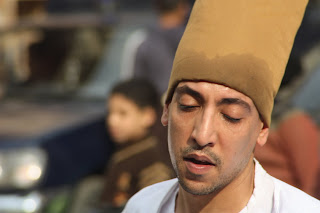
P.S. We know that we cannot spell human rights. We are working on a solution, but so far bare with us :-)
Subscribe to:
Posts (Atom)